Paired Evaluation for Prompt A/B Tests: 50 Input Floor and MLflow

Prompt A/B testing runs two or more prompt versions against the same inputs to prove whether a wording or instruction change actually improves your quality metric. The standard workflow is offline first: build a representative eval set, score both variants with the same judge, and only promote a winner to a live canary once the offline signal holds. Teams typically track a primary quality score alongside a guard-rail metric like resolution rate or refusal rate before touching production traffic.
TL;DR:
- Running prompt A/B tests requires a representative eval set of at least 50 inputs, measurable primary metrics, and logging infrastructure to ensure reliable results.
- Prompt variants must be stored as immutable files with versioned hashes, and all changes should be carefully recorded to allow reproducibility and debugging.
- Deterministic traffic splitting based on hashing user identifiers ensures consistent variant assignment and accurate measurement across sessions.
- Offline evaluation should precede live rollout, starting at low traffic percentages and only increasing after guard-rail metrics remain stable.
- Using tools like MLflow streamlines prompt versioning, validation, and observability, helping teams incorporate rigorous experiments into their prompt engineering pipeline.
Table of Contents
- What Is A/B Testing Prompts, and When Should You Run It?
- How Do You Create and Version Prompt Variants?
- How Do You Choose Metrics and Build Reliable Scorers?
- Experiment Design: Paired Evaluation, Sample Size, and Confidence Intervals
- Building Deterministic Traffic Splitting and Telemetry
- Offline Evals vs. Online Canary: How Do You Roll Out Safely?
- How Do You Interpret Results and Decide to Roll Out?
- Common Mistakes and a Pre-Launch Checklist
- Where MLflow Fits: Versioning, Judging, and Observability
- How to Integrate A/B Testing into Your Prompt Engineering Pipeline
- Real Cases Where Prompt A/B Testing Changed the Outcome
- Tools and Platforms That Support Prompt Testing
- What Are the Ethical and Privacy Considerations?
- The Editorial Take: Statistics Discipline Beats Prompt Cleverness
- Get Reproducible Prompt Testing With MLflow
- Sources
- FAQ
What Is A/B Testing Prompts, and When Should You Run It?
Not every prompt tweak deserves a formal test. If you're fixing an obvious typo or adjusting whitespace, ship it and move on. Prompt A/B testing earns its overhead when the input distribution is genuinely diverse, the outcome is measurable, and rolling back a bad change is expensive or slow.
Support bots, coding assistants, document extraction pipelines, and multi-agent orchestration flows are the classic candidates. Each faces enough input variety that a change helping one cohort might quietly hurt another, and that's exactly the kind of regression a quick manual glance won't catch.
Before you invest the engineering time, confirm you have three things in place:
- A labeled eval set with at least 50 representative inputs, ideally covering edge cases and common failure modes
- One primary metric you can actually measure automatically, not just eyeball
- Logging infrastructure that captures prompt version, output, and outcome for every call
If any of those three is missing, build it before you write variant B. Skipping this step is the single most common reason prompt tests produce noise instead of signal.
How Do You Create and Version Prompt Variants?
Treat every prompt like a build artifact, not a string you edit in place. The moment you change a system message and don't record what changed, you lose the ability to reproduce or debug the result later.
A workable pattern for prompt versioning looks like this:
- Store the full prompt artifact (system message, few-shot examples, response format instructions) as an immutable file, never edited after creation.
- Assign each version a name, an integer, and a content hash, following the pattern engineers at ML4Devs recommend of one prompt per file.
- Keep a separate hash for the fully rendered call, including injected context, so you can forensically reconstruct exactly what the model saw for any logged request.
- Add a CI check that fails the build if a prompt file changes without a version bump.
- Access prompts through typed accessors in code, never raw string concatenation, so a broken reference fails loudly instead of silently.
Pro Tip: Hash the rendered prompt, not just the template. Two calls using "version 3" can differ if a retrieved document or user variable changes what actually gets sent to the model, and that's often the detail that explains a confusing per-case result later.
How Do You Choose Metrics and Build Reliable Scorers?
A good primary metric passes three tests: it's measurable without a human in the loop for every case, it moves when the prompt changes, and it's sensitive enough to detect the lift you actually expect. A vague metric like "helpfulness" fails the second test unless you operationalize it into a rubric.
Three scorer types cover most situations, and most mature test setups combine them:
- Deterministic assertions — regex matches, schema validation, or exact-answer checks for tasks with a verifiable ground truth.
- LLM-as-a-judge — a second model scores outputs against a rubric, useful for open-ended quality but only after you validate it against human judgment on a sample.
- Human blind review — the slowest and most expensive option, reserved for high-stakes changes or judge calibration.
Validating a judge means running it against a set of human-labeled examples and confirming agreement before trusting it on your full eval set. Once validated, combine the quality score with guard-rail metrics. Optimizely's field research makes the same point in a conversion context: a win on one metric that quietly degrades cost, latency, or refusal rate isn't a real win.
Guard rails to track alongside quality: latency (p50 and p95), token cost per call, and refusal rate.
Experiment Design: Paired Evaluation, Sample Size, and Confidence Intervals
Paired evaluation, running variant A and variant B against the exact same inputs, cuts variance dramatically compared to unpaired sampling, because you're measuring the difference on identical questions rather than comparing two different random draws. Preserve the input order, context, and any retrieved documents identically across both runs, or you've introduced a confound before you've even started.
Sample size depends entirely on the lift you need to detect. Masterprompting show that detecting a 10 percentage point improvement (say, 60% to 66%). Smaller lifts need far more data.
| Minimum detectable effect | Approximate samples per variant |
|---|---|
| 10 percentage points | ~200 |
| 5 percentage points | 50 or more |
| Small pilot / directional signal | 50 (minimum recommended) |
For a first pass, practical guidance from AI/TLDR suggests 50 inputs as a floor and 100 to 200 once your application is mature enough to need finer-grained detection.
Because LLM score distributions rarely follow a clean normal curve, bootstrap resampling on paired differences gives more honest confidence intervals than a standard t-test. If you need to look at results before reaching your target sample size, use a pre-registered sequential testing method rather than just peeking and stopping when the number looks good. Peeking early without correction is the fastest way to convince yourself a random fluctuation is a real effect.

Building Deterministic Traffic Splitting and Telemetry
Assignment has to be deterministic and sticky, meaning the same user gets the same variant every time they interact with your system for the duration of the test. The standard pattern hashes a stable identifier, typically experiment_id:user_id, into a bucket, then maps that bucket to a variant according to your traffic weights.
- Compute a hash of the combined experiment and user ID string.
- Map the hash output to a number between 0 and 1.
- Assign the variant based on where that number falls relative to your traffic split (a 50/50 test splits at 0.5).
- Log the assignment once per session, not once per call, to avoid drift within a conversation.
- Never store mutable assignment state that a later deploy could silently change.
This approach, documented in production A/B testing patterns, avoids the need for a separate assignment database and stays reproducible if you need to replay the experiment later.
Your event schema should capture, at minimum: variant name, prompt version hash, user ID, conversation ID, input and output token counts, latency, and the judge or assertion outcome for that call.
Pro Tip: Log the prompt version hash on every single event, not just at experiment start. If you patch a live prompt mid-test without realizing it, the hash is the only thing that will catch the contamination before it poisons your results.
Offline Evals vs. Online Canary: How Do You Roll Out Safely?
Offline evaluation on a labeled set proves directional signal cheaply, before any real user sees the new prompt. Tools like promptfoo automate this side-by-side comparison against a fixed test suite, though they can't replace online validation entirely since real traffic surfaces inputs your eval set never anticipated.
Once offline results look strong, move to a canary:
- Start at a small traffic percentage, often 5 to 10%, and hold it long enough to accumulate your calculated sample size.
- Monitor guard-rail metrics continuously, not just at the end of the window.
- Ramp gradually (5% to 25% to 50% to 100%) only after each stage clears its thresholds.
- Abort immediately if any guard-rail metric regresses, or if a critical user cohort shows a quality drop, even if the aggregate number looks fine.
How Do You Interpret Results and Decide to Roll Out?
Declaring a winner requires two things simultaneously: a meaningful, statistically supported lift on your primary metric, and no regression on any guard rail you pre-committed to watching.
Before trusting the headline number, break it down:
- Inspect per-case diffs directly. Read the actual outputs where the variants disagree, not just the score.
- Segment results by question kind or user cohort. Averaging across dissimilar input types can hide a regression in one segment behind a gain in another.
- Check the pre-declared decision thresholds you set before the test started, and resist the urge to tune them after seeing results, since that turns a controlled test into a foregone conclusion.
If the data is ambiguous, that's a valid outcome. Extend the test or redesign the eval set rather than forcing a call.
Common Mistakes and a Pre-Launch Checklist
The most common failure is a tiny eval set that produces a confident-looking number built on five or ten examples. Close behind: changing the model and the prompt in the same test, which makes it impossible to attribute the result to either one, and stopping a test the moment the numbers look favorable instead of waiting for your calculated sample size.
Before launching, confirm:
- Both prompt variants are versioned, hashed, and stored as immutable files.
- Your judge or assertion logic has been validated against a human-labeled sample.
- Sample size is calculated for your target minimum detectable effect, not guessed.
- Logging hooks capture variant, version hash, and outcome for every call.
- Guard-rail thresholds are written down before traffic starts, with an abort rule attached.
- A canary plan exists with defined ramp stages.
If something goes wrong post-launch, your version hashes and event logs are what let you reconstruct exactly which prompt produced which output and roll back cleanly.
Where MLflow Fits: Versioning, Judging, and Observability
MLflow stores prompt artifacts as immutable, hashed versions and traces every experiment call, which covers the reproducibility problem this entire methodology depends on. Its LLM-as-a-judge evaluation framework automates scoring against rubrics, and its observability layer tracks the guard-rail metrics, latency, cost, refusal rate, that a test needs to stay honest once it hits production traffic.
How to Integrate A/B Testing into Your Prompt Engineering Pipeline
A/B testing works best when it's a native step in your prompt lifecycle, not a bolt-on experiment run by one engineer with a notebook. The practical integration point is your CI/CD pipeline for prompts: every proposed change to a production prompt should trigger an automatic offline evaluation against your fixed eval set before it's eligible for a canary.
Structure the pipeline in three gates. First, a pull request that modifies a prompt file automatically runs the new version against the existing eval set and posts a diff report, quality score, latency, refusal rate, against the current production version. Second, if the offline diff clears a pre-set bar, the change becomes eligible for a canary deployment at low traffic, gated by the same logging and hashing infrastructure described earlier. Third, only after the canary clears its guard-rail thresholds does the prompt get promoted to full production and its version becomes the new baseline for the next round of tests.
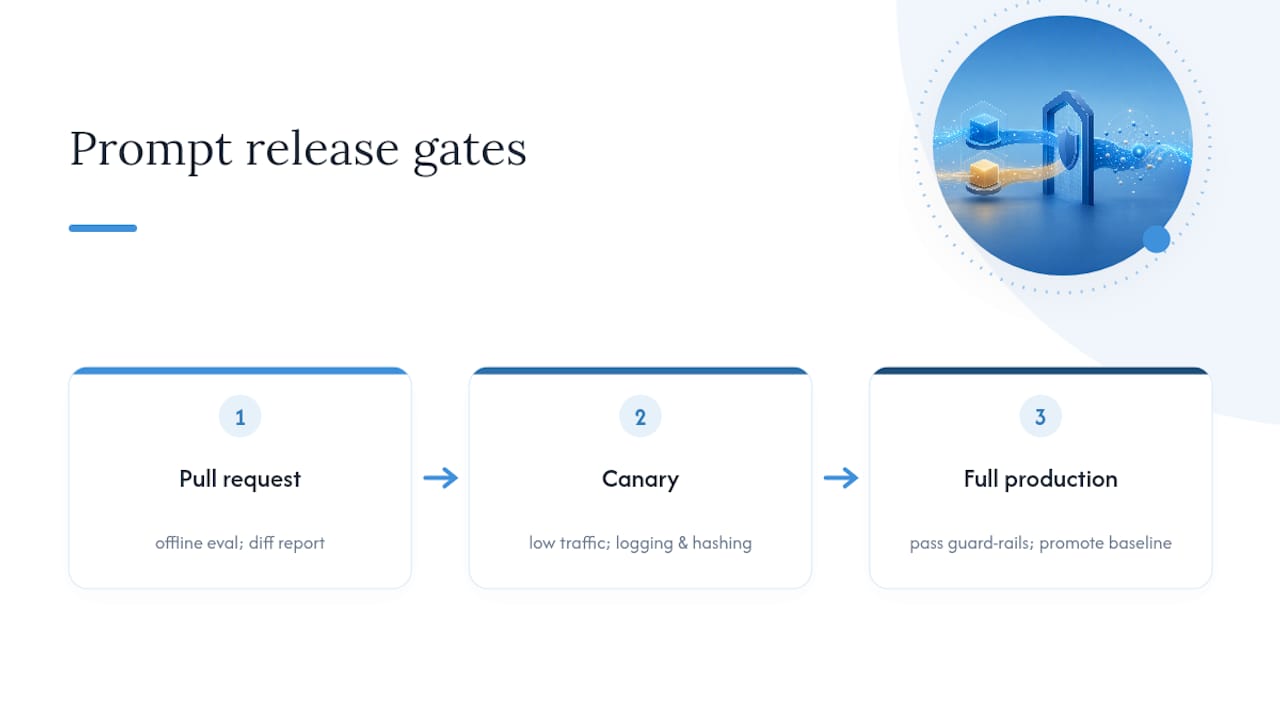
This turns prompt changes into the same reviewable, revertible artifact as code changes. Engineers stop treating prompt edits as informal tweaks and start treating them as changes with a measurable before-and-after, exactly the discipline that conversion optimization teams have applied to web experiences for years. The prompt equivalent just needs LLM-specific scoring instead of click-through rate.
One practical detail matters here: keep your eval set itself under version control too. If you silently change the test set between prompt iterations, you lose the ability to compare results across rounds, which defeats the entire point of building a pipeline in the first place.
Real Cases Where Prompt A/B Testing Changed the Outcome
A customer support bot handling ticket triage is a common scenario for this kind of test. A team suspects a more directive system prompt, one that explicitly instructs the model to ask a clarifying question before attempting resolution, will improve first-contact resolution rate. Rather than shipping the change to all users, they run both prompt versions against a paired eval set of historical tickets, scoring resolution accuracy with an LLM judge validated against past human-labeled outcomes. The directive version wins on resolution rate but adds a full turn of latency to every conversation, a guard-rail cost that only shows up because the team was tracking it alongside the primary metric.
Document extraction pipelines tell a similar story. A team testing whether adding explicit few-shot examples of edge-case invoices improves field-extraction accuracy finds the change helps invoices with unusual layouts but slightly hurts accuracy on the simplest, most common invoice format, the kind that made up the bulk of their eval set's easy cases. Without segmenting results by document type, the aggregate score would have looked like a clean win. Inspecting per-case diffs by category revealed the trade-off before it reached production.
Multi-agent orchestration flows raise the stakes further, since a prompt change to one agent's instructions can ripple into how a downstream agent interprets its output. Teams running these tests typically isolate the change to a single agent's prompt version and hold every other component fixed, using the same paired evaluation discipline described earlier, precisely because untangling a regression across multiple interacting prompts after the fact is far harder than catching it in a controlled comparison first.
Tools and Platforms That Support Prompt Testing
Offline comparison tooling has matured quickly. Promptfoo lets teams define a test suite once and run any number of prompt or model variants against it, generating side-by-side comparison reports without writing custom scoring infrastructure from scratch. It's a strong starting point for the offline gate in a pipeline, though it works best paired with a judge validated on your own labeled data rather than a generic out-of-the-box rubric.
For teams that need the full lifecycle, versioning, judge-based evaluation, and production observability, in one system rather than stitching together separate tools, MLflow's approach centers on treating prompts as first-class tracked artifacts alongside the traces and metrics generated when they run. That matters because the hardest part of prompt testing usually isn't running one experiment; it's keeping every past experiment's prompt versions, eval results, and production telemetry connected months later when someone asks why a metric moved.
Automation options extend beyond scoring. CI integrations can gate prompt merges on eval results automatically, and some teams wire canary promotion into their existing feature-flag infrastructure, treating a prompt variant exactly like any other flagged rollout. The through-line across every mature setup is the same: manual, one-off testing doesn't scale past a handful of prompts, and the moment a team is running more than two or three concurrent experiments, some form of automated pipeline integration becomes necessary just to keep results attributable to the right version.
What Are the Ethical and Privacy Considerations?
Running a live prompt experiment means real users interact with an unproven variant, which raises legitimate questions beyond pure statistics. If a canary variant is more likely to produce an incorrect or unsafe response, even briefly, that risk needs to be weighed against the value of the test, particularly for anything touching health, legal, or financial guidance.
The OWASP GenAI Top 10 guidance for agentic applications flags exactly this category of risk: prompt changes that alter refusal behavior or safety guard rails deserve extra scrutiny before any live exposure, since a variant optimized purely for a quality score could inadvertently loosen a safety constraint. Testing refusal rate as a guard-rail metric, not an afterthought, is how you catch this before it reaches users at scale.
Privacy matters just as much as safety. Logging full conversation content, user IDs, and outputs for experiment analysis means that data is now part of your test infrastructure, subject to whatever retention and access controls govern the rest of your production logs. Anonymizing or hashing user identifiers in experiment telemetry, and being deliberate about how long raw outputs are retained, keeps a testing pipeline from quietly becoming a data liability. The NIST AI Risk Management Framework offers a structured way to think through exactly this kind of risk-versus-benefit tradeoff before a canary goes live, and it's worth building into your test approval process rather than treating as a compliance afterthought.
Finally, be honest internally about sample bias. If your canary traffic skews toward a specific user segment (early adopters, a particular geography, a particular time zone), a result that looks like a clean win might not generalize once the prompt reaches your full population.
The Editorial Take: Statistics Discipline Beats Prompt Cleverness
Most of the advice circulating about prompt testing focuses on the wrong variable. Teams obsess over wording, tone, and clever instruction phrasing, and treat the actual measurement as an afterthought, a quick before-and-after glance rather than a designed experiment — you can learn more about this approach in how to humanize AI text with instructions. That ordering is backwards. A brilliant prompt change tested on 15 examples with an unvalidated judge tells you nothing, while an unremarkable, incremental change tested with a proper paired eval set and a validated scorer tells you exactly what you need to know.
The conventional advice also underweights guard rails. Plenty of teams ship a quality win without checking what happened to latency, cost, or refusal rate, then discover the regression three weeks later in a support queue. Treating those metrics as equal citizens to your primary score, not secondary concerns, is the single highest-leverage habit in this entire methodology.
If you take one thing from this: build the eval set and the sample-size math before you write variant B. The versioning, the hashing, the deterministic traffic splits, all of it exists to protect a result that only means something if the underlying statistics were sound in the first place. Get that order right, and everything downstream, canary rollout, decision rules, rollback safety, gets dramatically simpler.
— Kevin
Get Reproducible Prompt Testing With MLflow
Some platforms offer a full lifecycle solution for this methodology in a single open-source platform instead of multiple disconnected scripts: immutable prompt versioning with hashed identifiers, an LLM-as-a-judge evaluation framework that can be validated against your own labeled data, and production observability that tracks the guard-rail metrics, latency, cost, refusal rate needed to keep tests honest after rollout. Availability of every feature without enterprise paywalls enables small teams to run the same rigorous versioning and evaluation practices as larger ones.
If you're running your first paired eval or scaling past a handful of concurrent experiments, start with the Mlflow GenAI and LLM engineering page to see how prompt tracking and evaluation connect, then explore the LLM-as-a-judge documentation to set up a validated scorer for your own eval set. From there, the Mlflow platform overview has everything you need to deploy and start tracking your first experiment today.
Sources
- NIST AI Risk Management Framework
- OWASP GenAI Top 10 for agentic applications (2026)
- 101 A/B testing ideas to improve conversions — Optimizely field notes
- Masterprompting
FAQ
What Are Some Examples of A/B Testing for Prompts?
Common examples include testing a directive system message against a more open-ended one for a support bot, comparing few-shot examples against zero-shot instructions for document extraction, and testing whether adding explicit formatting rules improves structured-output accuracy. Each case pairs identical inputs across both variants and scores them with the same validated metric.
What Are the Five Types of Prompts?
Definitions vary across sources, but prompts are commonly grouped by function: instructional (direct commands), few-shot (with examples), zero-shot (no examples), chain-of-thought (reasoning steps requested explicitly), and role-based (assigning the model a persona or context). For A/B testing purposes, the type matters less than whether you can hold everything except one variable constant between versions.
What Are the Best Prompts for Testing AI?
There's no single "best" test prompt. What matters is a representative eval set, ideally 50 to 200 inputs, that reflects the real distribution of questions your application handles, including edge cases. A validated eval set built from real historical inputs will always outperform a handful of hand-picked examples for detecting genuine regressions.
Can You Explain A/B Testing in a Simple Way?
A/B testing means showing two versions of something, in this case two prompt variants, to comparable groups and measuring which one performs better on a specific outcome. For prompts, that usually means running both versions against the same inputs offline first, then promoting the winner to a small slice of live traffic before rolling it out fully.
Does MLflow Support A/B Testing Prompts?
Mlflow supports the core building blocks of prompt A/B testing: immutable, hashed prompt versioning for reproducibility, LLM-as-a-judge evaluation for scoring variants, and observability tooling to track guard-rail metrics during a canary rollout. Pricing details and deployment options are available directly on the Mlflow site.