Scale Human in the Loop LLMs with MLflow for Engineers

Human-in-the-loop for LLMs means routing specific agent decisions to a human reviewer before, during, or after execution, based on risk rather than habit. The three supervision modes are in the loop (the agent pauses and waits), on the loop (a human monitors while it runs), and out of the loop (full autonomy with retrospective audit). Our rule of thumb: gate anything irreversible or expensive to undo, and let everything else run with monitoring.
TL;DR:
- Human-in-the-loop systems should gate irreversible or high-cost actions, like production deletes or financial transactions, and relax gates as trust builds over time.
- Effective workflows combine decision routing, async review queues, detailed reviewer UIs, and structured feedback to turn reviews into training signals for model improvement.
- Deployments benefit from golden prompts for consistency and prompt canaries to safely test new models within 12 to 24 hours, with full rollout typically over a week.
- Building and maintaining review infrastructure involves significant operational costs, including tooling, latency, reviewer rotation, calibration, and bias mitigation.
- Mlflow supports traceability, evaluation, and version control for human-in-the-loop workflows but does not automate rubric creation or reviewer staffing.
Table of Contents
- What Is Human-in-the-Loop for an LLM, Exactly?
- Where Should You Put Human Approval Gates?
- Building the Core Human-in-the-Loop Workflow
- Golden Prompts and Canary Rollouts, Explained
- How Do You Pause and Resume an LLM Agent?
- Metrics That Decide When Humans Get Involved
- The Pitfalls That Break Human-in-the-Loop Programs
- Ethics and Bias in Human Review
- Does Human Review Actually Improve the Model?
- Scaling Human Review Without Drowning Your Team
- What Does a Human-in-the-Loop Program Actually Cost?
- Author Perspective: What Engineering Teams Underestimate
- Where MLflow Fits in Your Human-in-the-Loop Stack
- Sources
- FAQ
What Is Human-in-the-Loop for an LLM, Exactly?
The term gets thrown around loosely, so let's pin it down before going further. Human-in-the-loop (HITL) for LLMs is an architectural pattern, not a vague commitment to "having a human check things." It defines where in an agent's execution graph a human decision gets inserted, what data that human sees, and what happens to the agent's state while it waits.
IBM's framing of the pattern breaks supervision into three distinct modes, and matching the mode to the task's risk is the whole game.
- In the loop: the agent pauses execution and waits for explicit approval before proceeding. Think of an agent that drafts a wire transfer and cannot submit it until a human clicks approve.
- On the loop: the agent runs continuously while a human watches a dashboard, ready to intervene if something drifts. A support-ticket triage agent that a supervisor monitors in real time fits here.
- Out of the loop: the agent operates with no synchronous human touch point at all. Review happens after the fact, if at all, usually through sampled audits.
The mechanics differ sharply between modes. In-the-loop systems need synchronous pause and resume: the agent's execution graph halts, state gets persisted, and a resume call has to rehydrate it later. On-the-loop systems need an async queue and alerting, not a hard pause. Out-of-the-loop systems mostly need good logging and a sampling strategy for later spot checks.
Pick the mode based on cost of error versus cost of delay. A customer-facing chatbot answering FAQ questions can run out of the loop; a coding agent that pushes to production should not. Teams that default every action to in-the-loop review end up drowning reviewers in low-stakes approvals, and teams that default everything to out-of-the-loop discover regressions only after customers complain.
Where Should You Put Human Approval Gates?
Placing gates well is the single highest-leverage decision in the entire system. Get it wrong and you either bottleneck every agent run behind a human queue or let a costly mistake slip through unreviewed. Agentpatterns treats reversibility as the primary signal, and that framing holds up under practical use.
- Ask whether the action can be undone. A draft email is reversible; a sent one is not. A staging deploy is reversible; a production database delete is not. Gate the second category, not the first.
- Weight novelty. An agent taking an action it has never taken before, or operating outside its training distribution, deserves a gate even if the action type is usually low risk.
- Weight customer tier and blast radius. An error affecting one free-tier user costs less than one affecting an enterprise account with a service-level agreement attached.
- Weight tool side effects. Read-only tool calls (search, lookup, summarize) rarely need gates. Tool calls that write, delete, or transact almost always do.
- Weight regulatory exposure. Anything touching health, financial, or legal decisions inherits a lower risk tolerance regardless of reversibility.
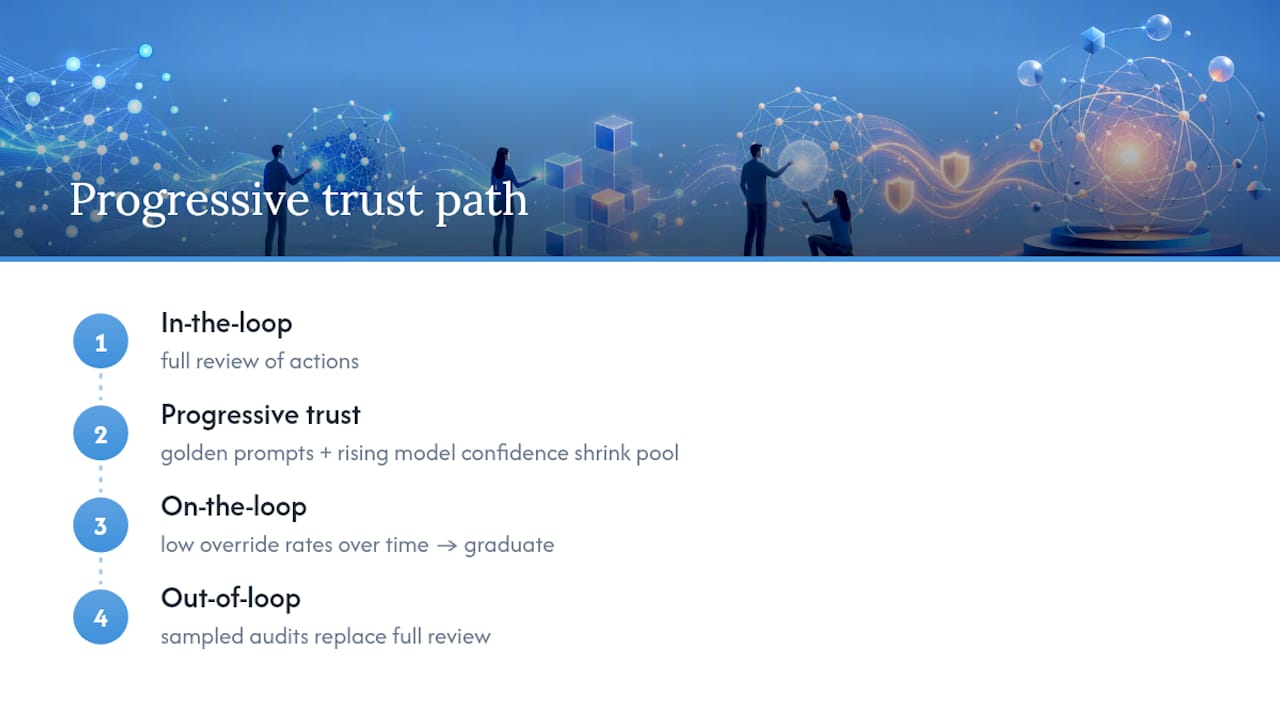
- Build a progressive trust plan. Start every new agent behavior with strict in-the-loop gating, then relax to on-the-loop monitoring, and eventually out-of-the-loop autonomy, once measured override rates stay low over a defined period.
That last point matters more than the rest combined. Static gate placement ages badly. What's genuinely novel in month one is routine in month four, and a gate that made sense at launch becomes a bottleneck nobody remembers approving.
Building the Core Human-in-the-Loop Workflow
Once you know where gates belong, you need the actual machinery: something that routes decisions, holds them, shows them to a reviewer, and captures what the reviewer did. Four components make up almost every production HITL workflow we've seen.
- Approval gates and routing logic. Routing should combine confidence score, computed risk tier, and customer tier into a single decision: auto-approve, queue for review, or escalate immediately.
- Async review queues with SLAs. Reviewers work in batches, not in real time, so queues need service-level targets (say, a 30-minute response window for high-priority items) and an escalation path when that window slips.
- A reviewer UI that shows reasoning, not just output. The interface needs to display the proposed action, the arguments the agent intends to pass, and the model's chain of reasoning, with the ability to edit before resuming execution.
- Structured feedback capture. Every review decision should log a preference pair, an edit span if the reviewer changed anything, and a reason code explaining why.
That fourth point is where most teams underinvest, and it's the one with the longest payoff. Reviewer decisions that only exist as an "approved" checkbox in a database are worthless for improving the model later. Structured capture of preference pairs, edit spans, and reason codes turns every review into training signal, exported weekly into your evaluation harness.
Pro Tip: Log the reviewer's edit as a diff against the original model output, not just the final text. The diff tells you exactly what the model got wrong, which is far more useful for prompt iteration than the corrected answer alone.
Reviewer UI design deserves more attention than it usually gets, too. A reviewer staring at a raw JSON blob of tool arguments will approve things they don't understand just to clear the queue. A reviewer looking at a rendered summary, a diff view, and a one-line risk explanation actually makes a judgment call. That difference shows up directly in your override rate and, eventually, in your incident count.
Golden Prompts and Canary Rollouts, Explained
Human review doesn't scale if every prompt change requires a fresh round of manual sign-off. Two engineering patterns exist specifically to cut down how often a human needs to touch anything at all: golden prompts and prompt canaries.
Golden prompts are governed, reusable prompt assets that encode the constraints and expected outputs a team has already agreed on. Atlassian describes them as alignment devices: once a team has defined what "good" looks like in a shared, versioned prompt, reviewers stop re-litigating basic quality questions and can concentrate their attention on genuine edge cases. Building one is a cross-functional exercise, not an engineering-only task. Product, legal, and support all need a say in what the golden prompt permits, because they're the ones who deal with the fallout when it's wrong.
Prompt canaries solve a different problem: how do you know a prompt or model change is safe before it hits everyone? The pattern borrows directly from software canary deployments.
- Run the new prompt in shadow mode first, generating outputs that get logged but never shown to users.
- Promote to a 5% canary, routing a small slice of live traffic to the new version while the rest stays on the stable prompt.
- Watch behavioral signals for a defined observation window before stepped promotion to larger traffic shares.
That observation window is not optional and not a formality. Canary rollout guidance for LLM production puts the typical window at 12 to 24 hours at 5% traffic for early behavioral signals to reach statistical confidence, with a fuller lagging-indicator check around 50% traffic over roughly seven days before calling the rollout safe.
The 5% rule: at a 5% traffic canary, many teams see behavioral drift show up in as little as 12 hours, but distribution-shift metrics on rarer intents can take the full 24-hour window to stabilize enough to trust.
The last piece is the deployment manifest. Treat the prompt text, the model version, and the retrieval index as a single pinned artifact, the same way you'd pin a container image. Without that pinning, a "rollback" might restore the old prompt while leaving the RAG index on a newer version, and you'll spend a confusing afternoon debugging a regression that isn't actually there.
How Do You Pause and Resume an LLM Agent?
Everything above assumes the agent can actually stop and wait without losing its place. That requires a persistent state store, commonly called a checkpointer, that captures the full execution graph, the conversation thread, and any pending tool calls at the moment of interruption.
LangGraph's architecture for interrupt and resume is the reference pattern most teams build against, whether or not they use LangGraph itself. The mechanics work like this:
- An
interrupt()call inside the graph halts execution and serializes state under athread_id, so the same run can be located and resumed later. - The checkpointer writes that state to durable storage, not memory, so a service restart doesn't destroy an in-flight approval.
- Resume semantics accept an edited value from the human reviewer and rehydrate the run exactly where it paused, injecting the correction rather than restarting the whole chain.
- The approval item itself needs a lifecycle: pending, approved, edited-and-approved, rejected, and expired.
That last state, expired, is the one teams forget until it bites them. A paused run with no timeout policy can sit in a queue indefinitely, holding resources and, worse, leaving a customer staring at a spinner. Build a timeout into every approval item from day one: after a set window, escalate to a backup reviewer or fail safely with a clear message, rather than letting the run hang.
- Notify reviewers through the channel they actually check, whether that's Slack, email, or an in-app queue, not just a database row nobody polls.
- Log every state transition of an approval item as an audit record, including who acted, when, and what the original versus edited values were.
- Treat resume as a write operation with its own validation; a corrupted or malicious edited value passed back into a running graph is a real attack surface, not a theoretical one.
Metrics That Decide When Humans Get Involved
Routing decisions and canary promotions both depend on watching the right signals, and most teams start with too few of them. Leading indicators catch problems fast but noisily; lagging indicators are slower but more trustworthy.
- Output length distribution shifts often precede a quality problem and are cheap to monitor continuously.
- Refusal rate spikes usually mean a prompt change made the model more cautious than intended, or less cautious in the wrong direction.
- Format compliance (valid JSON, required fields present) is one of the fastest signals to compute and one of the first to break after a model swap.
- Re-query rate, how often a user immediately asks a follow-up because the first answer missed, is a strong behavioral proxy for quality.
- Edit-to-accept ratio in the reviewer UI tells you how often humans are rubber-stamping versus genuinely correcting.
- Session abandonment after a given agent response flags outputs that quietly failed the user without triggering an explicit complaint.
Behavioral monitoring for canaries also recommends LLM-as-a-judge scoring against a fixed rubric, run continuously against sampled traffic, alongside semantic similarity checks against a stable baseline set of outputs.
| Signal type | Example metric | Typical use |
|---|---|---|
| Leading | Refusal rate, format compliance | Fast canary health check, minutes to hours |
| Behavioral proxy | Re-query rate, edit-to-accept ratio | Session-level quality signal, hours to days |
| Judged | LLM-as-a-judge score vs. rubric | Continuous sampled quality audit |
| Lagging | Override rate, incident count | Canary promotion decision, days |
Auto-rollback triggers should combine at least one leading and one lagging signal, since a single noisy metric crossing a threshold is not a safe reason to roll back a canary on its own. A tool built for LLM observability can tie a specific trace directly to the review item it generated, which turns "the refusal rate spiked" into "here are the seventeen traces that caused it."
The Pitfalls That Break Human-in-the-Loop Programs
Most HITL failures aren't technical. They're organizational, and they show up as decision fatigue: reviewers approve dozens of near-identical items a day and start clicking "approve" faster than they're actually reading. Rubber-stamping is the predictable outcome of asking humans to do vigilant, careful work at a volume no human sustains.
Synchronous gates create the second common failure: bottlenecks. If every gated action blocks the agent until a human responds, your system's latency ceiling is whatever your slowest reviewer's response time happens to be. Agentpatterns.ai's guidance on gate placement is blunt about this: misplaced gates are the primary operational failure mode, more damaging than skipping review entirely in some cases, because over-gating creates a false sense of safety while quietly destroying throughput.
- Prefer async queues over synchronous pauses wherever the task tolerates a delay of minutes rather than seconds.
- Rotate reviewers regularly; the same person reviewing the same category of decision for months develops blind spots.
- Inject negative samples (known-bad outputs) into the review stream periodically to check whether reviewers are still catching real problems.
- Enforce SLAs with visible dashboards, not just a policy document nobody reads.
- Require reason codes on every decision, not free text, so calibration reviews can actually be quantified.
- Run monthly rubric calibration sessions where reviewers score the same sample set independently and compare results.
Pro Tip: Track inter-annotator agreement on your calibration samples the same way you'd track any model metric. A drop in agreement between reviewers is often the earliest warning sign that your rubric has gone stale or your task has gotten harder than the guidelines account for.
Ethics and Bias in Human Review
Putting a human in the loop doesn't remove bias from the system. It relocates it. A reviewer pool skewed toward one demographic, one language, or one cultural context will approve and reject outputs based on their own frame of reference, and that frame becomes baked into your training data through every preference pair you export.
Rubric design is where this gets addressed, or ignored. A rubric that says "flag anything offensive" without concrete examples leaves every reviewer applying their own threshold, and thresholds vary widely by background and personal experience. A rubric with specific, calibrated examples across a representative range of cases produces far more consistent decisions, and consistency is what lets you trust the aggregate signal.
There's also a subtler ethical issue in who bears the cost of review labor. Content moderation and RLHF annotation work has a documented history of being outsourced to lower-wage workforces reviewing psychologically taxing material, and LLM HITL programs risk repeating that pattern if reviewer wellbeing isn't part of the program design from the start. Rotation policies help here too, for reasons beyond calibration: no single reviewer should carry the bulk of your most disturbing edge cases indefinitely.
Audit logs matter for a second reason beyond debugging: they create accountability. When a reviewer's decision is traceable, with a timestamp, a reason code, and their identity attached, the incentive to rubber-stamp drops, and the ability to investigate a bad outcome after the fact goes up substantially.
Does Human Review Actually Improve the Model?
Yes, but only if the review data gets used, and a surprising number of teams build the review queue and never close the loop back into training or prompt iteration. The value of human-in-the-loop review isn't the individual approval or rejection. It's the structured record that approval leaves behind.
Every edit a reviewer makes to a model's output is a labeled example of the gap between what the model produced and what a human considered correct. Exported as preference pairs and edit spans into an evaluation harness, that gap becomes the exact signal you need to fine-tune, adjust a prompt, or retrain a retrieval index. Teams that skip this step get a safer production system today and a static model forever; teams that capture it get a system that measurably improves.
Two metrics tell you whether the loop is actually working: human touch rate and override rate. Touch rate is the percentage of agent actions that require human review at all. Override rate is the percentage of reviewed actions where the human changed or rejected the model's proposal. A healthy program shows touch rate declining over time (because golden prompts and calibration are working) while override rate on the remaining reviewed items stays informative rather than trending to zero, which would suggest reviewers have started rubber-stamping instead of genuinely evaluating.
Academic and applied research on HITL integration, including domain-specific work like LLM A* search patterns for robotics applications, reinforces that the pattern generalizes well beyond chat interfaces into planning and manufacturing contexts, wherever an agent's proposed action carries real-world cost if wrong.
Scaling Human Review Without Drowning Your Team
The math is unforgiving: if your agent volume grows 10x and your touch rate stays flat, you need 10x the reviewer capacity, and reviewer hiring never scales that fast. Scalability in HITL systems comes from reducing touch rate intelligently, not from hiring your way out of the problem.
Golden prompts and rising model confidence should progressively shrink the population of actions that need review, following the progressive trust plan described earlier. As override rates on a given action category stay low over a measured period, that category graduates from in-the-loop to on-the-loop, and eventually out-of-the-loop with sampled audits replacing full review.
Batching helps too, but only when the task tolerates delay. Grouping similar approval items into a single reviewer session, rather than interrupting a reviewer's flow with one-off pings, cuts context-switching overhead and tends to improve decision quality, not just throughput.
The organizational side matters as much as the technical one. A single reviewer team supporting every product line eventually becomes a shared bottleneck that no engineering fix solves. Distributing review responsibility across teams that own the specific agent behavior they're reviewing, with a shared rubric and shared tooling, scales further than a centralized review desk ever will.
What Does a Human-in-the-Loop Program Actually Cost?
Reviewer headcount is the obvious cost, but it's rarely the biggest one. The tooling to support review, queue infrastructure, checkpointer storage, audit logging, and a usable reviewer UI, takes real engineering time to build and maintain, and it's easy to underestimate because none of it is visible in a demo.
Latency is a cost too, just a less obvious one. Every synchronous gate adds the reviewer's response time directly to your agent's end-to-end latency, and that delay has a real business cost if it sits in a customer-facing flow. Async queues avoid blocking the user experience but shift the cost into engineering complexity: you now need a way to notify the user later, handle a paused state gracefully, and avoid the appearance of a broken system.
There's a real trade-off between building this in-house and using platform tooling that already handles evaluation, tracing, and observability. Building your own review queue, checkpointer, and evaluation export pipeline from scratch is a multi-quarter engineering investment for most teams, and one that duplicates work an open-source platform has already solved. The ongoing cost isn't just infrastructure either; rubric calibration sessions, reviewer rotation planning, and reason-code taxonomy maintenance are recurring operational overhead that someone on the team owns permanently, not a one-time setup cost.
Author Perspective: What Engineering Teams Underestimate
The trade-off nobody states plainly enough: every gate you add buys safety and spends latency, and most teams price that trade wrong in both directions. They over-gate at launch out of caution, then under-invest in relaxing gates later because nobody owns that decision.
Start with a single high-risk gate, not a blanket policy. Measure it for a real period before adding a second one. And treat SLAs, preference-pair collection, and monthly calibration as the actual product, not the paperwork around it. The gate is cheap to build. The discipline to run it well is not.
— Kevin
Where MLflow Fits in Your Human-in-the-Loop Stack
Mlflow is an open-source platform built for exactly the operational needs this playbook describes: observability that traces agentic reasoning down to the individual tool call, automated evaluation through LLM-as-a-Judge scoring, and centralized governance over prompt versions across providers. If you're building the approval-gate routing, canary observation, and reviewer-feedback export described above, you need somewhere to trace it, score it, and version it, and that's the gap Mlflow is built to close.
The evaluation workflows page covers how automated metrics and human feedback combine in practice, which maps directly onto the preference-pair and edit-span capture discussed earlier. The LLM-as-a-Judge tooling supports exactly the rubric-based scoring a canary promotion decision depends on, and it's free to try since Mlflow is fully open source with no feature paywall separating a prototype setup from a production one.
Mlflow won't write your rubric or staff your reviewer rotation. What it gives you is a place to standardize the tracing, evaluation, and prompt governance underneath a human-in-the-loop program, so the engineering discipline you build doesn't live in disconnected scripts. If you're at the point of wiring gates, queues, and canaries into a real pipeline, MLflow's landing page and its GenAI and agent engineering overview are the two places to start looking at how the pieces fit your stack.
Sources
For deeper technical grounding, IBM's HITL agent tutorial covers supervision modes in depth. Agentpatterns.ai details gate placement rules. Atlassian explains golden prompts, and this canary deployment guide covers rollout timing. LangGraph's architecture writeup explains checkpointer mechanics, and arXiv's LLM A* paper shows research-side applications.
- Human-in-the-loop AI agent patterns (IBM)
- Human-in-the-Loop placement: where and how to supervise agent pipelines
- Behind the demo: turning golden prompts into real customer value (Atlassian)
- Prompt canaries: the deployment primitive your AI team is missing
- LangGraph agent architecture and interrupt/checkpointer patterns
FAQ
What Is Human-in-the-Loop for LLMs?
Human-in-the-loop for LLMs is an architecture where a person reviews, approves, or monitors specific agent decisions rather than letting the model act fully autonomously. The three supervision modes (in the loop, on the loop, out of the loop) determine how tightly that oversight is applied.
What's the Difference Between Golden Prompts and Prompt Canaries?
Golden prompts are governed, versioned prompt templates that encode agreed-upon quality standards so reviewers don't re-debate basic expectations. Prompt canaries are a rollout technique that routes a small percentage of traffic to a new prompt or model version to catch regressions before a full release.
How Long Should a Prompt Canary Run Before Full Rollout?
Most behavioral signals at a 5% traffic canary need 12 to 24 hours to reach statistical confidence, with a fuller lagging-indicator check around 50% traffic over roughly a week before full promotion. Rarer intents or subtler drift can take the full window to stabilize.
Where Should Approval Gates Go in an Agent Pipeline?
Gates belong before irreversible or high-cost actions, such as financial transactions, production deploys, or permanent deletions, and should generally be skipped for reversible, low-risk steps like drafting or read-only lookups. Reversibility is the primary placement signal, followed by novelty, customer tier, and regulatory sensitivity.
Does MLflow Support Human-in-the-Loop Workflows?
Mlflow provides the observability, LLM-as-a-Judge evaluation, and prompt versioning that a human-in-the-loop program needs to trace decisions, score outputs, and govern prompt changes across providers. It's an open-source platform with no published price, and current details are available directly on Mlflow's site.