Engineers: Cross-Provider Failover With MLflow and Typed Fallbacks

Cross-provider failover is a resilience pattern that routes inference requests to an alternate model provider when the primary one becomes unavailable, preserving continuity of service. It doesn't preserve output parity. Switching from one provider's model to another changes tone, latency, and sometimes correctness, so the pattern trades a hard outage for a softer, managed degradation. The rest of this guide covers the failure classes that trigger a switch, the typed fallback logic that handles each one correctly, and the observability you need to know it's working.
TL;DR:
- Cross-provider failover shifts traffic away from a degraded provider based on health signals, not a one-time error, to prevent outages at the system level.
- Not all errors trigger the same response; rate limits demand immediate failover, while server errors justify retries before switching providers.
- Effective failover systems include retries with jitter, typed fallback chains for different error classes, and circuit breakers to prevent cascading failures.
- Monitoring key metrics like failover count, error rates, and latency, alongside structured health checks, ensures failover works reliably and is compliant.
- MLflow aids governance by automatically tracing requests, evaluating fallback responses, and centralizing prompt management across providers.
Table of Contents
- What Is Cross-Provider Failover, Exactly?
- Mapping Failures to the Right Response
- Building the Failover Stack: Retries, Breakers, and Routing
- Watching It Work: Health Checks and Metrics
- Keeping Failover Compliant Across Providers
- Auditing Failover Decisions With MLflow
- Writing Runbooks That Actually Get Used During an Outage
- When Failover Is Worth Building, and When It Isn't
- How MLflow Supports Multi-Provider Governance
- Standards Worth Knowing
- Sources
- FAQ
What Is Cross-Provider Failover, Exactly?
Cross-provider failover, provider fallback, and retry logic are used interchangeably in casual conversation, but they solve different problems and mixing them up leads to broken architecture.
A retry resends the same request to the same provider, usually after a brief delay, on the assumption the failure was transient. A fallback is a single substitution: when the primary model fails a specific call, one designated backup handles it. Failover is the broader system behavior, an ongoing shift of traffic (or a subset of it) away from a degraded provider until it recovers, governed by health signals rather than a one-off error.
The complication underneath all three is model non-equivalence. Providers don't share tokenizers, so a prompt that fits comfortably in one context window can overflow another. Function-calling schemas differ in how arguments are typed and validated. A JSON response that parses cleanly from one provider might need a repair step from another.
- Retry: same provider, same request, short delay
- Fallback: one substitution, one designated backup
- Failover: sustained traffic shift based on health signals
Improving single-provider resilience (better retries, regional redundancy within one vendor) solves transient blips. Cross-provider failover is for provider-level outages, sustained rate-limiting, or contractual risk from depending on a single vendor.
Mapping Failures to the Right Response
Not every error deserves the same reaction, and treating a rate limit like a server crash (or vice versa) wastes retries or triggers an outage that didn't need to happen. Distinguishing HTTP-layer failures from semantic ones is where most home-built failover logic falls short, according to production LLMOps guidance.
A 5xx server error usually deserves one or two short retries with backoff before failover triggers. A 429 rate-limit response should skip retries entirely and fail over immediately since the primary is telling you it's already overloaded. A context-window error means the payload is fine but the target model is wrong for it, so route to a larger-context model rather than a different provider blindly. A content-policy block is neither a bug nor an outage. It calls for a structured error response or a routed attempt to a provider with different moderation thresholds, never a blind retry.
| Failure type | Signal | Recommended action |
|---|---|---|
| Server error | 5xx | Short retry with backoff, then failover |
| Rate limit | 429 | Immediate failover, no retry |
| Context overflow | Token count error | Fallback to larger-window model |
| Policy block | Moderation flag | Structured error or alternate provider |
| Timeout mid-stream | Partial response | Resume or restart with state check |
Streaming responses complicate all of this. A failure mid-stream means the client already has a partial answer, and restarting from scratch on a different provider can produce a jarring, duplicated, or contradictory continuation. Semantic health checks, sending a lightweight canary prompt and validating structure or content, catch cases where a provider returns 200 OK but the actual output is degraded, empty, or off-topic.
Pro Tip: Never treat a 429 as a retry candidate. Rate limits are the provider explicitly asking you to route elsewhere right now, and hammering it with retries only extends your own outage.
Building the Failover Stack: Retries, Breakers, and Routing
A working system layers three mechanisms, and skipping any one of them leaves a gap that surfaces during exactly the outage you built the system to survive.
- Retries with jittered backoff. Handle transient 5xx errors locally, on the same provider, before escalating. Jitter matters more than most teams assume. Uniform backoff across thousands of clients recovering simultaneously creates a thundering herd against the provider that just came back online, a pattern engineering guides on provider outages flag as a common cause of secondary failures.
- Fallback chains, typed by error class. A rate limit, a context-window overflow, and a policy block each need a different backup target, not one universal "next provider in the list." Typed fallbacks materially cut wasted attempts compared to a single catch-all chain.
- Circuit breakers. Once error rates on a provider cross a threshold over a defined window, open the breaker and stop sending traffic entirely for a cooldown period, rather than letting every request pay a timeout penalty against a provider that's clearly down.
Routing strategy determines how traffic gets distributed once the chain exists. Weighted routing lets you smoke-test a new provider on a small percentage of production traffic before trusting it fully. Latency-based routing shifts traffic toward whichever endpoint is currently fastest. Classifier-based routing sends different request types to different providers based on task complexity. Hedging, firing a duplicate request to a second provider when the first is slow to respond, trades extra cost for lower tail latency, according to production routing patterns documented across OpenAI, Anthropic, and Google configurations.
Warming matters as much as routing logic. Backup providers that never see traffic go cold, meaning their first real request under failover conditions hits an unfamiliar code path and higher latency. Sending 5 to 20 percent of normal traffic to backups continuously keeps those paths warm and turns failover into a smoke test rather than a leap of faith.
Pro Tip: Set circuit breaker cooldowns longer than your provider's typical incident duration, or you'll flap between open and closed states and make an outage look worse than it is.
Watching It Work: Health Checks and Metrics
Health checks fall into three categories, and most teams only build the first one. Transport probes confirm the endpoint responds. Semantic probes send a canary prompt and check the answer against an expected pattern. Function-call validation confirms tool-calling schemas still parse correctly, since a provider can be "up" by every transport measure while quietly breaking structured output.
Track these metrics at minimum:
failover_count: how often traffic actually shifted providersrouter_exhaustion_total: requests that failed every option in the chainprovider_error_rate: per-provider error rate, not aggregated- P99 latency, split by provider
semantic_failure_rate: canary or schema validation failures
Alerts should trigger weight shifts before a circuit breaker fully opens, giving the system room to degrade gracefully. Logs need to record which provider served each request, associated cost headers, and normalized response metadata, since reconstructing a routing decision after the fact without that record is close to impossible.
Keeping Failover Compliant Across Providers
A fallback chain that silently routes a request to a non-compliant endpoint is a compliance failure disguised as a resilience feature, and it's one of the easier mistakes to make when the routing logic only checks for availability.
- Restrict fallback chains to providers covered by your existing BAA or HIPAA scope; document which endpoints qualify before they enter the chain, not after an incident.
- Use virtual keys or scoped, short-lived credentials for each provider rather than long-lived secrets baked into routing config, aligning with control guidance from CIS Controls.
- Run pre-send redaction and secrets detection on outbound payloads, since a fallback event is exactly when a rushed configuration change is most likely to leak something it shouldn't.
- Keep immutable audit logs of every provider selection decision, a practice NIST's AI Risk Management Framework frames as core to trustworthy AI governance.
Cross-border data residency deserves its own line item. A fallback provider in a different jurisdiction can violate residency commitments even when it solves the outage cleanly, so region-aware gateways need to enforce that a request never leaves its approved geography regardless of which provider ends up serving it. Automated, non-human routing decisions also carry identity risks worth reviewing against the OWASP Non-Human Identities Top 10, since a compromised routing credential can quietly redirect production traffic.
Auditing Failover Decisions With MLflow
Every failover event is a decision, and a decision without a record is a decision you can't defend later, whether the audience is an engineering postmortem or a compliance review. MLflow's tracing captures each inference call with the provider that served it, the latency, and the response metadata, which turns a failover incident from a guess into a reconstructible timeline.
- The platform's tracing instruments each call end to end, recording which provider handled the request and why, giving you the audit trail that manual logging rarely captures consistently.
- The platform's LLM-as-a-Judge evaluation runs automated checks against fallback responses, catching semantic drift a transport-level health check would miss entirely.
- Centralized prompt management through an AI Gateway keeps prompt versions consistent across providers, so a failover event doesn't accidentally introduce an unversioned prompt variant into production.
- A typical workflow: capture the trace, assert the response schema, log provider metadata alongside cost and latency, then trigger an automated evaluation pass before considering the failover event closed.
Kevin, who covers GenAI platform engineering for this publication, has spent years watching teams treat observability as an afterthought until the first real outage forces the issue.
Writing Runbooks That Actually Get Used During an Outage
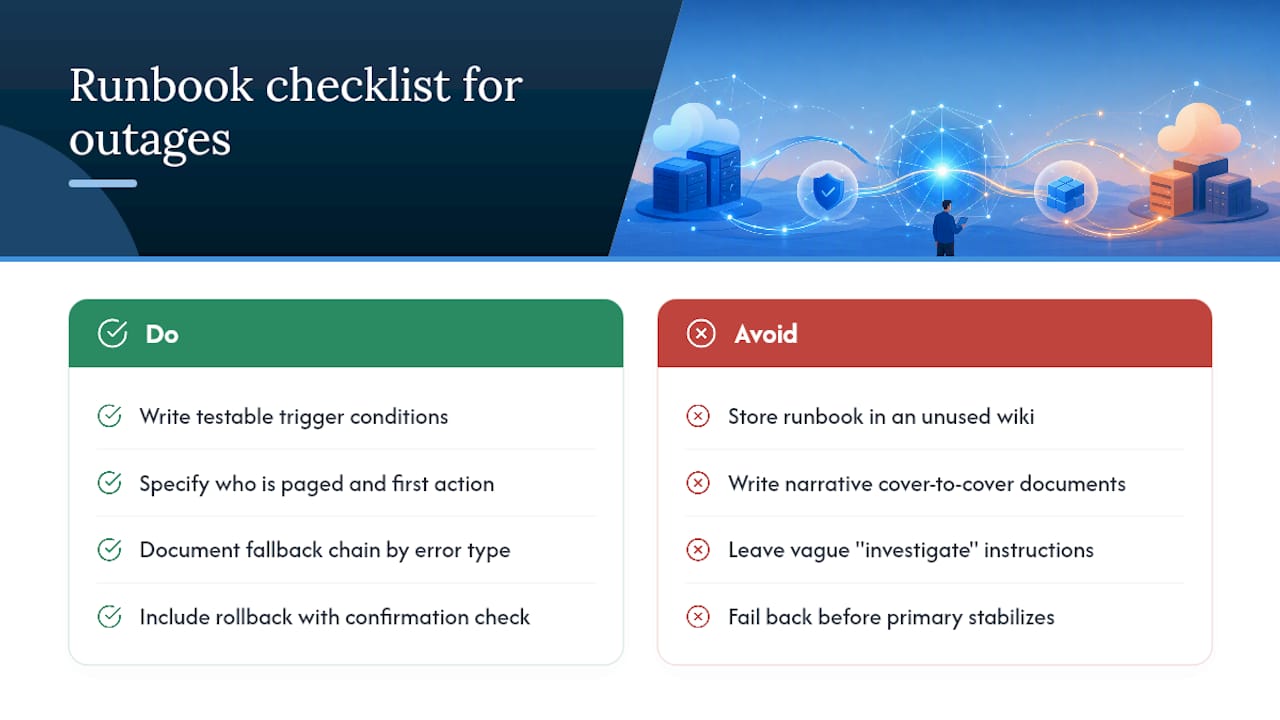
A failover runbook that lives in a wiki nobody opens during an incident is worse than no runbook, because it creates false confidence that a plan exists. The best ones read like a checklist an on-call engineer can execute half-awake at 3 a.m., not a narrative document meant to be read cover to cover.
Start with trigger conditions written in plain, testable terms: which specific metric crossing which specific threshold justifies manual intervention, separate from what the automated system already handles. If provider_error_rate for a given vendor crosses 15 percent over five minutes, the runbook should say exactly who gets paged and what command or dashboard they open first, not just "investigate the issue."
Document the fallback chain itself, including which provider handles which error type, so a human stepping in during a partial outage doesn't have to reverse-engineer the routing config under pressure. List the known behavioral differences between providers, tone shifts, formatting quirks, latency baselines, so whoever is watching customer-facing output during a failover event knows what's expected versus what's a new problem.
Every runbook needs a rollback section that's just as detailed as the failover trigger. Teams write extensively about how to fail over and barely mention how to fail back, which is exactly backward, since failing back prematurely (before a provider has genuinely stabilized) can trigger a second incident. Include a confirmation step: run the semantic health check against the primary for a defined window before shifting weight back.
Version the runbook alongside the routing configuration it describes. A runbook referencing a circuit breaker threshold that changed six months ago is a liability during the exact moment it needs to be trustworthy.
When Failover Is Worth Building, and When It Isn't
Full cross-provider failover pays off when SLA commitments or recovery-time objectives demand it, and the cost of downtime exceeds the engineering overhead of maintaining and testing multiple integrations. When brand voice or behavioral consistency matters more than raw uptime, same-model redundancy across infrastructure providers is often the smarter bet. Pin routes for style-critical paths; reserve cross-provider failover for flows where availability outranks tone.
— Kevin
How MLflow Supports Multi-Provider Governance
Building the failover logic is one project. Proving it worked, tracking which provider handled which request, and catching semantic drift before a customer does, is a separate and ongoing one. That's the gap MLflow's platform is built to close.
MLflow pairs deep tracing of agentic reasoning with a centralized AI Gateway for cross-provider governance, so the health checks, metrics, and audit logs this guide describes don't have to be stitched together from scratch. Traces capture provider decisions automatically. LLM-as-a-Judge evaluation runs against fallback outputs to catch the semantic drift a transport-level check misses. Prompt management stays versioned and centralized across every provider in your fallback chain, which matters most during the exact moment you're routing traffic somewhere new under pressure.
Because MLflow is open source under Linux Foundation governance, there are no enterprise feature paywalls blocking the observability or gateway controls a production failover system needs. Review the MLflow GenAI and agent engineering documentation to see how tracing and evaluation map to your own routing architecture, or start with the MLflow project page to explore the full platform.
Standards Worth Knowing
Formal governance frameworks give failover architecture a shared vocabulary auditors and security teams already trust. The NIST AI Risk Management Framework covers risk identification for AI systems generally, while the NIST Cybersecurity Framework maps directly onto the detect, respond, and recover functions this guide's alerting section relies on. The CIS Controls offer prioritized technical controls for credential and secrets governance, and the OWASP Non-Human Identities Top 10 addresses risks specific to automated, machine-driven routing decisions. ISO 42001 rounds this out for teams aligning failover governance with international AI management standards.
Sources
- NIST AI Risk Management Framework
- Failover Across OpenAI, Anthropic, and Google: A Production Pattern | Gateway-LLM
FAQ
What Does Failover Mean in an LLM Context?
Failover means automatically routing inference requests to a backup provider or model when the primary becomes unavailable or degraded, based on ongoing health signals rather than a single failed request. It's a sustained behavior, not a one-time substitution.
What's the Difference Between Failover and a Simple Failure?
A failure is a single event, one request that didn't succeed. Failover is the system-level response to failures, the mechanism that detects a pattern of degradation and shifts traffic elsewhere until the primary recovers.
What Is Dual-Provider (or Dual-WAN Style) Failover for LLM Traffic?
Borrowed from networking's dual-WAN concept, this means maintaining two independent provider connections simultaneously, with one designated primary and one standing by, warmed with a small percentage of live traffic. If the primary degrades, traffic shifts to the pre-warmed backup instead of a cold failover target.
How Much Does It Cost to Run Cross-Provider Failover?
Costs come from three places: paying for API access across multiple providers, the warming traffic sent to backups to keep them ready, and the engineering time to build and test the routing logic. There's no fixed industry figure, since it scales with request volume and how many providers a chain includes. MLflow itself carries no license cost since it's open source, though teams should budget separately for the provider API usage the gateway routes across.
Should Every Application Implement Full Cross-Provider Failover?
Not necessarily. Applications with strict uptime commitments or high switching costs during outages benefit most, while style-sensitive or low-traffic applications may do better pinning a single provider and accepting occasional downtime over the complexity of maintaining multiple integrations.